
Raven Max or Raven Flash? How to choose the model for the job
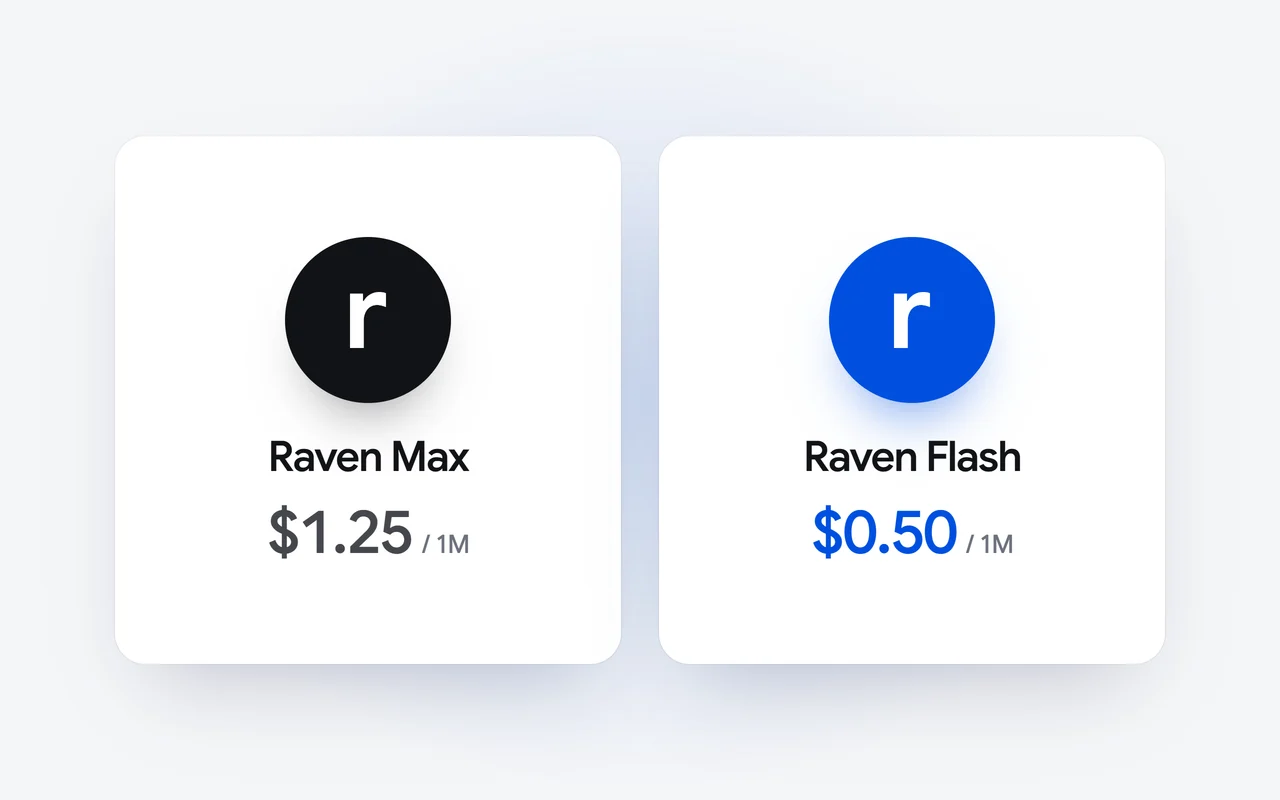
Use Raven Flash for fast, high-volume work: coding agents, interactive chat, CI/CD pipelines and classification at scale. Use Raven Max when the work is long and a mistake is costly: refactors, architecture, formal research and hard bugs. Both read 1M tokens of context and write up to 128K, and you can switch between them at any time.
Key facts
- Raven Flash: autonomous coding in DCode, interactive chat, CI/CD pipelines and high-volume classification; $0.50 input and $2.50 output per 1M tokens.
- Raven Max: codebase refactoring, complex architecture, formal research and hard bug triage; $1.25 input and $6.25 output per 1M tokens.
- Both: a 1M-token context window, up to 128K tokens of output, images, tool calls and reasoning you can read.
- First in their own tables of our published results: Raven Max on Terminal Bench 4.0, Agent's Last Exam and GDPVal-AA; Raven Flash on Terminal Bench 4.0 and AutomationBench, and level first on the Intelligence Index.
- Choose per request in the DipoleML API with the model field, and switch at any time in DCode and the Raven app.
Raven Max and Raven Flash are the two models of the Raven family. They share far more than they differ, and both are on every Raven plan. This piece is about the difference: what each one is built for, where each placed first in our published results, what each costs, and how to send each job to the right one.
What do the two models have in common?
Both take up to 1M tokens of context and write up to 128K tokens of output; our story on the long window shows what that holds. Both read images alongside text, call your tools natively and show their reasoning before they answer. Both run in the Raven app and in DCode, and both are served through the DipoleML API. So the choice is not about what a model can read. It is about the work.
Which work goes to Raven Flash?
Raven Flash is our high-velocity model, built for low latency, responsive autonomous agents and high-frequency code execution. Its key workloads are autonomous coding in DCode, interactive chat, CI/CD pipelines and high-volume classification: work where answers have to come quickly and often.
In our published results, Raven Flash is first among the models it is compared with on Terminal Bench 4.0 (34.1) and AutomationBench (49.2), and level first on the Intelligence Index (43) with two other models. It costs $0.50 per 1M input tokens, $0.05 for cached input and $2.50 per 1M output tokens.
Which work goes to Raven Max?
Raven Max is our flagship reasoning model, built for complex engineering, long-horizon planning and decisions where errors are costly. Its key workloads are codebase refactoring, complex architecture, formal research and hard bug triage: work that runs over many dependent steps, where one wrong step undoes the rest.
In our published results, Raven Max is first among the models it is compared with on Terminal Bench 4.0 (42.8), Agent's Last Exam (39.5) and GDPVal-AA (1,771). It costs $1.25 per 1M input tokens, $0.13 for cached input and $6.25 per 1M output tokens: 2.5 times Raven Flash's input and output prices.
Each model is ranked in its own table, among the models it is compared with. Every result is in our report on Raven Max and our report on Raven Flash; both are company-reported and were evaluated with maximum reasoning effort.
How do the two compare side by side?
| Raven Max | Raven Flash | |
|---|---|---|
| Built for | Complex engineering, long-horizon planning, decisions where errors are costly | Low latency, responsive autonomous agents, high-frequency code execution |
| Key workloads | Codebase Refactoring, Complex Architecture, Formal Research, Hard Bug Triage | Autonomous Coding in DCode, Interactive Chat, CI/CD Pipelines, High-Volume Classification |
| Context window | 1M tokens | 1M tokens |
| Output limit | 128K tokens | 128K tokens |
| Input, cached, output per 1M tokens | $1.25, $0.13, $6.25 | $0.50, $0.05, $2.50 |
| First in our published results | Terminal Bench 4.0, Agent's Last Exam, GDPVal-AA | Terminal Bench 4.0, Automation |
How do they score on the same tests?
Both models took the same eight tests. Raven Max scores higher on seven of them. On AutomationBench, Raven Flash scores higher: 49.2 to 48.3. Pick a test to see the two side by side.
Raven Max and Raven Flash on the same testsScore
| Model | Score |
|---|---|
| Raven Max | 42.8 |
| Raven Flash | 34.1 |
| Model | Score |
|---|---|
| Raven Max | 39.5 |
| Raven Flash | 26.6 |
| Model | Score |
|---|---|
| Raven Flash | 49.2 |
| Raven Max | 48.3 |
| Model | Score |
|---|---|
| Raven Max | 1771 |
| Raven Flash | 1651 |
| Model | Score |
|---|---|
| Raven Max | 68.7 |
| Raven Flash | 65.4 |
| Model | Score |
|---|---|
| Raven Max | 47 |
| Raven Flash | 43 |
| Model | Score |
|---|---|
| Raven Max | 62.8 |
| Raven Flash | 55.8 |
| Model | Score |
|---|---|
| Raven Max | 1522 |
| Raven Flash | 1462 |
Evaluated with maximum reasoning effort enabled. Source: Dipole ML Inc. Technical Report (October 2026).
How do I switch between them?
- The DipoleML API. Every request names its model in the
modelfield,Raven FlashorRaven Max, so you can send each request to the model that suits it. - DCode. Pick the model in the model picker and switch at any time, in the middle of a task too. The conversation carries on with the new model.
- The Raven app. Pick the model in the message box before you send.
In code, the choice is one argument. With the OpenAI SDK pointed at our base URL:
from openai import OpenAI
import os

client = OpenAI(
    base_url="https://api.dipoleml.com/v1",
    api_key=os.environ["RAVEN_API_KEY"],
)

def ask(prompt, hard=False):
    # Raven Max for long, high-stakes work, Raven Flash for the rest
    return client.chat.completions.create(
        model="Raven Max" if hard else "Raven Flash",
        messages=[{"role": "user", "content": prompt}],
    )
The model names and their limits are in the Models docs, and switching in DCode in Model settings.
Is there a simple rule to start with?
Start on Raven Flash. Move a request to Raven Max when the work runs over many dependent steps, when the first answer does not pass your check, or when a mistake would be expensive to undo. In DCode, one rhythm that works well is to explore and draft with Raven Flash, then switch to Raven Max for the change that has to be right. Each model has its own page, Raven Max and Raven Flash, and the prices are on the pricing page.
Product names are trademarks of their owners and are used here only to identify the products.
Questions and answers
Which model should I start with?
Raven Flash, for most everyday and high-volume work: it is the fast one and costs less. Move a request to Raven Max when the work runs over many dependent steps or a mistake would be expensive. In DCode, one rhythm that works well is to explore and draft with Raven Flash, then switch to Raven Max for the change that has to be right.
Do the two models have different context windows?
No. Both take up to 1M tokens of context and write up to 128K tokens of output, so the choice is about the work, not the length of what you send.
Is Raven Max ahead of Raven Flash on every test?
No. On the eight tests of our published results, Raven Max scores higher on seven, and Raven Flash scores higher on AutomationBench.
Can I use both models on one plan?
Yes. Both Raven models are on every Raven plan, Free included, in the Raven app and in DCode. Through the DipoleML API, you pay per token from prepaid credits at each model's own price.
First published Last updated