
Run Raven Max in Claude Code and other coding tools
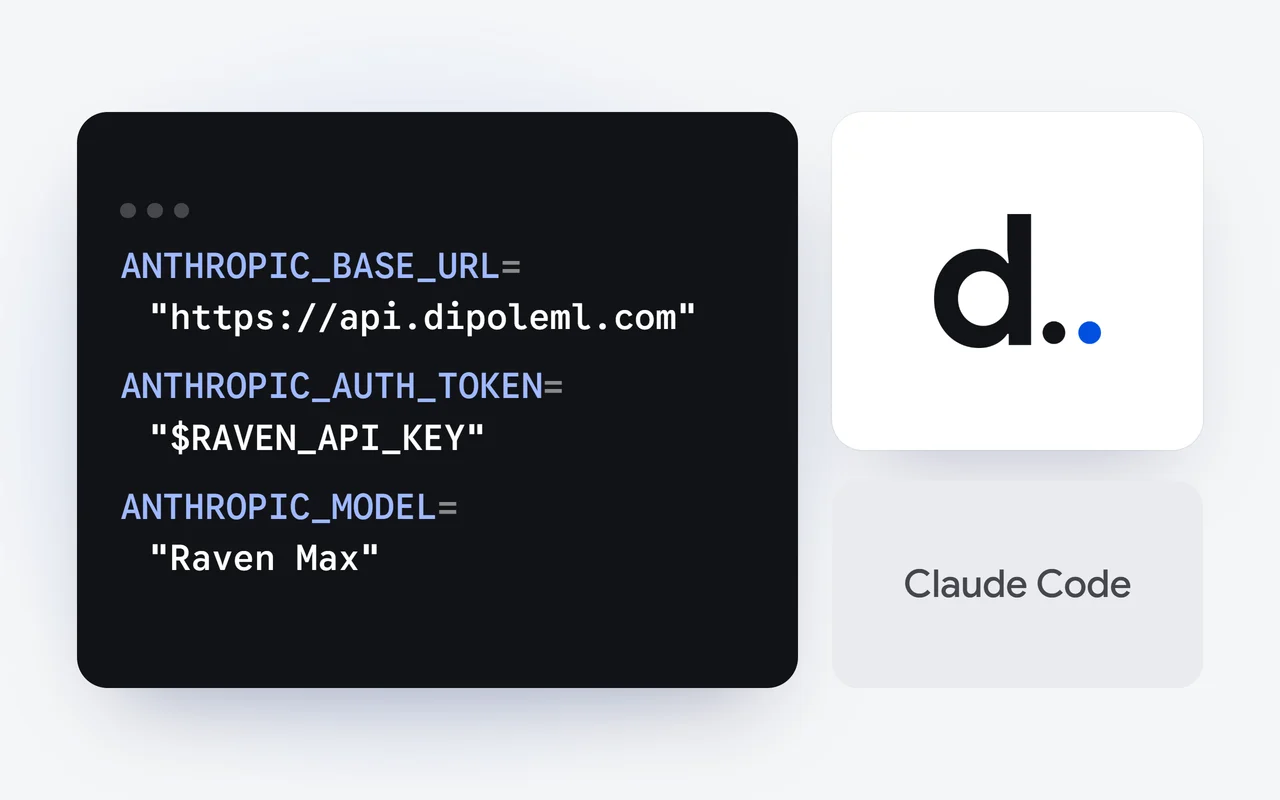
On November 12, 2026, the DipoleML API, from Dipole ML Inc., began answering in the Anthropic SDK format at POST /v1/messages, beside the OpenAI format, with the same keys, credits and prices. Claude Code runs Raven Max with four settings: our base URL, your key, and Raven Max and Raven Flash as the model names.
Key facts
- POST https://api.dipoleml.com/v1/messages answers in the Anthropic SDK format, with the same keys, credits, prices and limits as Chat Completions.
- Claude Code takes four settings: ANTHROPIC_BASE_URL, ANTHROPIC_AUTH_TOKEN, ANTHROPIC_MODEL and ANTHROPIC_DEFAULT_HAIKU_MODEL.
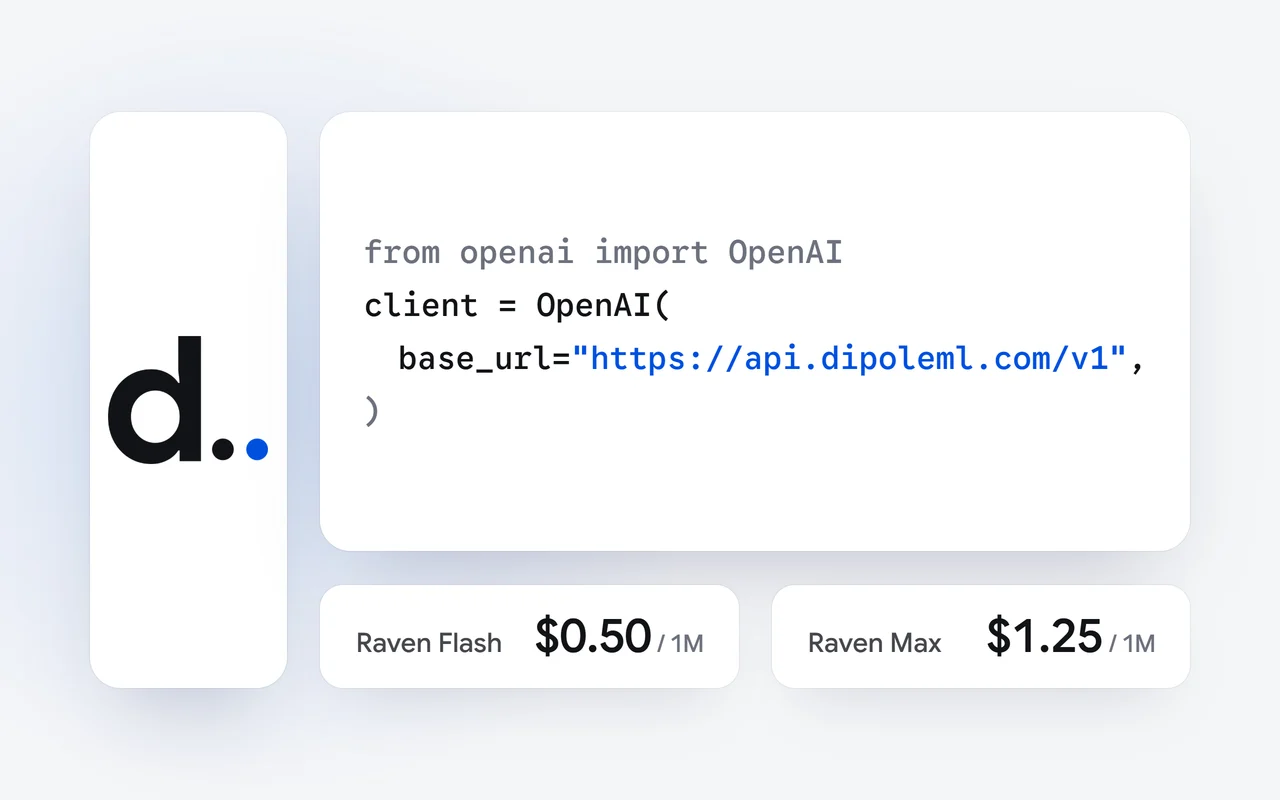
- Tools of the OpenAI format use the base URL https://api.dipoleml.com/v1; Anthropic SDK clients use https://api.dipoleml.com, without /v1.
- Per 1M tokens, Raven Max costs $1.25 input, $0.13 cached and $6.25 output, paid from prepaid credits in both formats.
- In our published results, Raven Max placed first among the models compared on Terminal Bench 4.0, at 42.8.
On November 12, 2026, the DipoleML API began answering in a second SDK format. Beside Chat Completions in the OpenAI format, POST /v1/messages now answers in the Anthropic SDK format, with the same keys, credits and prices. Any coding tool that lets you add a model provider of either format can run Raven Flash and Raven Max. This guide sets up Claude Code, which Anthropic describes as an agentic coding tool that reads your codebase, edits files, runs commands and integrates with your development tools, and then the tools of the OpenAI format.
What changed on November 12?
- A second format. Raven Flash and Raven Max answer at
POST https://api.dipoleml.com/v1/messagesin the Anthropic SDK format, as they have answered Chat Completions in the OpenAI format since launch day. - The same account. Keys, credits, prices and limits are the same in both formats.
- Either header. In the Anthropic SDK format, the key goes in
x-api-keyor asAuthorization: Bearer. - Coding tools. A tool of either format uses Raven with a base URL, a key and the model names.
Create a key
On your dashboard, with credits. Keep it in RAVEN_API_KEY.
Set the base URL
https://api.dipoleml.com for Claude Code; with /v1 for OpenAI-format tools.
Name the models
Raven Max for hard reasoning, Raven Flash for fast, frequent work.
Work as usual
Each request bills your credits at the published prices.
What does a coding tool need?
Three things: a base URL, an API key and the model names. The base URL and the key header follow the format your tool speaks:
- The OpenAI SDK format, often called "OpenAI compatible": the base URL
https://api.dipoleml.com/v1, and the key asAuthorization: Bearer. - The Anthropic SDK format, the one Claude Code speaks: the base URL
https://api.dipoleml.com, and the key inx-api-keyor asAuthorization: Bearer.
Then add the models by name: Raven Max for hard reasoning and large changes, Raven Flash for fast, frequent work. Each name has a space in it, and letter case does not matter; if a config format cannot hold a space, put the name in quotes. A tool that lists a provider's models finds ours at GET /v1/models.
Watch the /v1. OpenAI SDK clients want the address with it; Anthropic SDK clients want it without, because they add /v1/messages themselves. A doubled or missing /v1 shows up as a 404.
How do I set up Claude Code with Raven Max?
- Create an API key on your dashboard and add credits.
- Put the key in an environment variable, such as
RAVEN_API_KEY, rather than in a config file you might commit. - Check that the key works. The answer lists Raven Flash and Raven Max; a
401means the key is wrong.
curl https://api.dipoleml.com/v1/models \
  -H "Authorization: Bearer $RAVEN_API_KEY"
Claude Code speaks the Anthropic SDK format. Set these four in the shell profile where you start it:
export ANTHROPIC_BASE_URL="https://api.dipoleml.com"
export ANTHROPIC_AUTH_TOKEN="$RAVEN_API_KEY"
export ANTHROPIC_MODEL="Raven Max"
export ANTHROPIC_DEFAULT_HAIKU_MODEL="Raven Flash"
Anthropic's environment variables reference describes ANTHROPIC_BASE_URL as the override for the API endpoint, and ANTHROPIC_AUTH_TOKEN as a custom value for the Authorization header, sent with Bearer in front. ANTHROPIC_MODEL names the model to use. ANTHROPIC_DEFAULT_HAIKU_MODEL is the model the haiku alias resolves to, which that reference says is also used for background functionality; these settings give that part to Raven Flash.
ANTHROPIC_API_KEY, which sends the key as x-api-key, works as well. Start Claude Code again after you change the settings, and choose the model with /model. Its requests are taken as they come, including the system messages it puts inside the conversation.
What does a call to /v1/messages look like?
Your own code can use the format too. Here is one call with curl, as the Messages docs write it:
curl https://api.dipoleml.com/v1/messages \
  -H "x-api-key: $RAVEN_API_KEY" \
  -H "anthropic-version: 2023-06-01" \
  -H "Content-Type: application/json" \
  -d '{
    "model": "Raven Max",
    "max_tokens": 1024,
    "system": "You are a concise technical editor.",
    "messages": [{"role": "user", "content": "Tighten this paragraph: ..."}]
  }'
The answer has the Anthropic SDK's shape: a content list of blocks, a stop_reason and a usage object. Cached input is counted in cache_read_input_tokens and billed at the cached price, and caching needs no setup. With the Anthropic Python SDK, set base_url to https://api.dipoleml.com, without /v1: the SDK adds the path itself.
How do tools of the OpenAI format connect?
In an editor or agent that offers an "OpenAI compatible" provider, choose it and fill in three fields:
- Base URL, sometimes called "API base" or "override base URL":
https://api.dipoleml.com/v1. - API key: your key, or the name of the environment variable that holds it, if the tool reads one.
- Model: Raven Max and Raven Flash, added by hand if the tool does not list them.
Your own code works the same way with the official OpenAI SDKs. What to look for in an API of that format, and how ours answers each point, is in our guide to OpenAI-compatible APIs.
What can a coding tool use?
- Chat calls, streaming, images, tool calling and reasoning, in both formats.
- Only the tool's own functions as tools. In the Messages format, a tool that runs on the server, such as web search, is refused with
400. - Not the Responses format:
POST /v1/responsesanswers404, so a tool that only speaks that format cannot use the API today.
When a tool does not connect, the error says why. A 401 with missing_api_key means no key arrived, or it came in a header its format does not use. A 404 with model_not_found means the model name is spelled another way than Raven Max or Raven Flash, with the space, and a 404 whose code is 404 means the base URL is wrong for the format. A 402 means the balance is empty or the key reached its cap.
What does it cost?
A tool's requests bill your API credits like any other call, at the same prices in both formats. Every price is per 1M tokens, in US dollars:
| Per 1M tokens | Raven Flash | Raven Max |
|---|---|---|
| Input | $0.50 | $1.25 |
| Cached input | $0.05 | $0.13 |
| Output | $2.50 | $6.25 |
Credits come in packs from $5, and they never expire. Each key can carry a spending cap and an expiry, which suits a key you give to a tool: our guide to keys shows how to set both.
Why run Raven Max in a coding agent?
Because agents do their work in the terminal, and that is where Raven Max placed first. In our published results, company-reported and evaluated with maximum reasoning effort, Raven Max placed first among the models compared on Terminal Bench 4.0, which measures autonomous software engineering in a live terminal, at 42.8, 0.4 ahead of Fable 5.
A bar chart of five scores on Terminal Bench 4.0, with Raven Max first at 42.8 and Fable 5 next at 42.4.
Terminal Bench 4.0Score
| Model | Score |
|---|---|
| Raven Max | 42.8 |
| Fable 5 | 42.4 |
| GPT-5.6 Sol | 37.9 |
| Muse Spark 1.3 | 33.3 |
| Gemini 3.8 Flash | 19.7 |
Evaluated with maximum reasoning effort enabled. Source: Dipole ML Inc. Technical Report (October 2026).
The margin is narrow, and Raven Max does not lead every test. On DeepSWE v1.1, GPT-5.6 Sol placed first at 70.2 and Raven Max fourth, at 68.7. For the quick, frequent turns of an agent, Raven Flash placed first among the fast models it is compared with on Terminal Bench 4.0, at 34.1. Every result is in our report on Raven Max.
Where do I go from here?
If you are still choosing the agent itself, our guide to Claude Code alternatives compares the terminal agents. DCode, our own agent, runs on the Raven models with your plan or your credits, and our story on DCode 2.5 covers its latest release. Everything the API does is on the developers page, and the prices are on the pricing page. The coding tools guide and the Messages format reference go further.
Product names are trademarks of their owners and are used here only to identify the products.
Questions and answers
Can I use Raven Max in Claude Code?
Yes. Set ANTHROPIC_BASE_URL to https://api.dipoleml.com, ANTHROPIC_AUTH_TOKEN to your DipoleML API key, ANTHROPIC_MODEL to Raven Max and ANTHROPIC_DEFAULT_HAIKU_MODEL to Raven Flash, then start Claude Code again. Its requests are paid from your API credits.
Do I need a different key for the Anthropic SDK format?
No. The same DipoleML API key works in both formats, with the same credits and prices. In the Anthropic SDK format, send it in x-api-key or as Authorization: Bearer.
Which base URL does my tool need?
Tools and SDK clients of the OpenAI format want https://api.dipoleml.com/v1. Anthropic SDK clients, Claude Code among them, want https://api.dipoleml.com, because they add /v1/messages themselves. A doubled or missing /v1 shows up as a 404.
First published Last updated